Since November 4, 2026, Sindhi Shagird Sath, a Sindhi student organization, has been protesting against Karachi University’s “Karachi Sindh Pakistan” (KSP) admission policy. The students have condemned the policy as genocidal, arguing that it directly obstructs Sindhi students’ access to higher education at one of Sindh’s major public universities. Rather than serving as a gateway to educational opportunity, the policy, they contend, has become a barrier to their academic advancement.
The KSP policy may come as a surprise to those unfamiliar with its admission criteria. Under this policy, priority is given to Karachi-based students, regardless of their academic performance. For instance, a student from Karachi with 55 per cent marks may be given preference, while a student from Sukkur, despite securing 80 to 90 per cent marks, could be denied admission. The disparity becomes even more troubling when Sindhi students are denied access to major academic disciplines in Karachi, the capital of their own province.
Sindhi students have questioned why such a discriminatory and exclusionary policy is being allowed to undermine their academic futures and career prospects. Why should a student’s place of residence take precedence over academic merit when both students belong to the same province?
Discrimination has been pervasive at Karachi University. We will not revisit the long history of systemic discrimination against Sindhis in Karachi’s educational institutions. However, it is important to recall that, since the creation of Pakistan, there has appeared to be a policy of pushing Sindhi students out of educational institutions.
It began with the relocation of the University of Sindh in the 1950s to Jamshoro, rather than allowing it to continue operating in Karachi. At the same time, Sindhi-medium schools were banned, despite the presence of a substantial Sindhi population in the city.
Moreover, many still remember the role of A.B. Haleem, whose views towards Sindhis were openly racist. To put it briefly, Sindhi students were never accorded priority from the very early stages of the educational system. This pattern of exclusion eventually found institutional expression in the KSP admission policy, adopted in the 1990s, which has served to restrict Sindhi students’ access to higher education in Karachi, the capital of their own province, Sindh.
Today, Pakistan’s elite media and politicians continue to beat the drum for the creation of new provinces, with Sindh repeatedly at the centre of their demands. Yet, they remain conspicuously silent about the racist and discriminatory KSP admission policy.
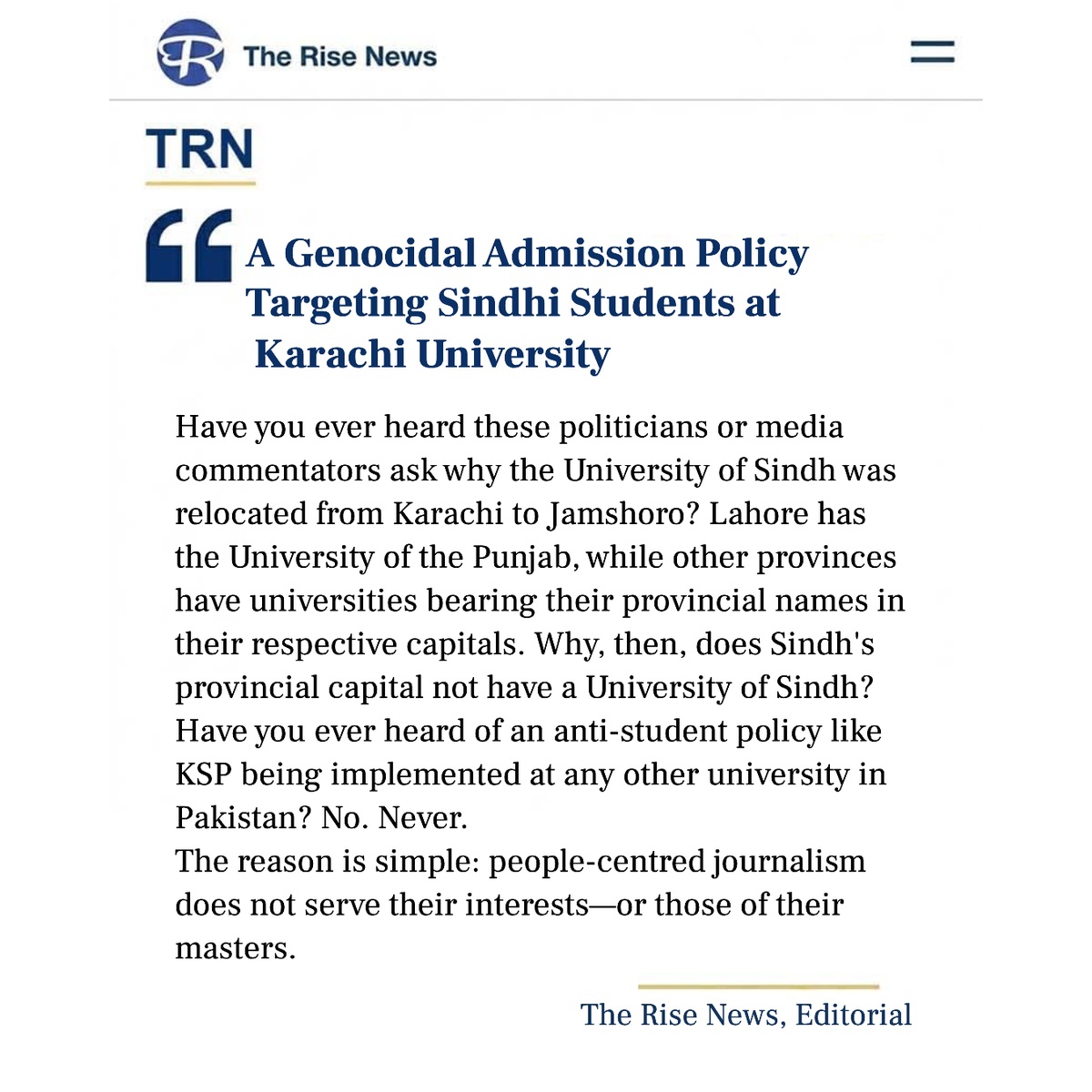
Have you ever heard these politicians or media commentators ask why the University of Sindh was relocated from Karachi to Jamshoro? Lahore has the University of the Punjab, while other provinces have universities bearing their provincial names in their respective capitals. Why, then, does Sindh’s provincial capital not have a University of Sindh?
Have you ever heard of an anti-student policy like KSP being implemented at any other university in Pakistan? No. Never.
The reason is simple: people-centred journalism does not serve their interests—or those of their masters.
The Rise News has reported on the students’ protest. Sources have told us that some university teachers allegedly made racist remarks, suggesting that the KSP policy would prevent “such Sindhi faces from villages” from gaining admission.
We believe that not all university teachers share such views. However, even if only a handful hold these attitudes, it is deeply troubling. Such educators are instilling prejudice and hatred in students’ minds rather than nurturing ideas, critical thinking and intellectual curiosity.
The responsibility now rests squarely on the shoulders of the Sindh government to abolish the KSP policy immediately, restore a merit-based admission system and ensure equal educational opportunities for all students. If Sindhi students cannot pursue higher education in their own provincial capital, where are they supposed to go—to Mars?
Hatred must not be instilled in the minds of the younger generation; doing so will only jeopardise their futures and career prospects. Equally, there must be zero tolerance for teachers who promote racism and prejudice within educational institutions.
The Sindh government’s foremost responsibility is to uphold students’ fundamental right to education and ensure that no room exists in the province for a genocidal policy targeting students. Education is a universal right, not a privilege reserved for a particular city or group. Sindhi students are equally entitled to that right.